

If you’ve had hemifacial spasm for a while, you’ve probably asked yourself: is there a better option?
Maybe you’ve tried medications. Maybe you’ve been getting Botox injections every few months. The treatments may have helped at first, but now the relief feels less predictable. For many patients, symptom management no longer feels like enough.
When people search for the latest treatment for hemifacial spasm, they hope to find a breakthrough. The biggest advances haven’t come from brand-new medications. They’ve come from better imaging, more precise surgery, and a deeper understanding of which patients benefit from different treatments.
This guide covers the three main treatment options for hemifacial spasm, beginning with microvascular decompression (MVD), followed by Botox and medications. Each approach has different benefits, and the right choice depends on your symptoms, goals, and the underlying cause of your condition.
What Causes Hemifacial Spasm?
In most cases, a blood vessel presses against the facial nerve near the brainstem. Over time, the constant pulsing of that vessel irritates the nerve and disrupts its normal signals. The nerve fires on its own and triggers twitching. It often starts near the eye and moves to the cheek, mouth, or jaw.
Symptoms are often mild at the start. Many people assume the twitching comes from stress or fatigue. But unlike a temporary eye twitch, Hemifacial Spasm usually persists and can get worse over time. Because the problem is nerve compression, symptoms rarely go away on their own.
Because hemifacial spasm is most often caused by a blood vessel pressing on the facial nerve, many patients want to know whether treatment can address the source of the problem rather than simply manage symptoms. For some patients, microvascular decompression offers that possibility.
Microvascular Decompression (MVD): Treating the Source
Most cases of hemifacial spasm share one root cause: a blood vessel pushing on the facial nerve. So what happens when a surgeon relieves that pressure?
That’s the foundation of microvascular decompression for hemifacial spasm.
MVD is a surgical procedure that addresses the underlying cause. The surgeon moves the blood vessel away from the nerve and tucks a small cushion between them. This barrier prevents the vessel from continuing to irritate the nerve.
Unlike other hemifacial spasm treatment options, MVD addresses the underlying cause by relieving pressure on the facial nerve. For carefully selected patients, it may provide long-term relief by treating the source of the spasms rather than managing symptoms alone.
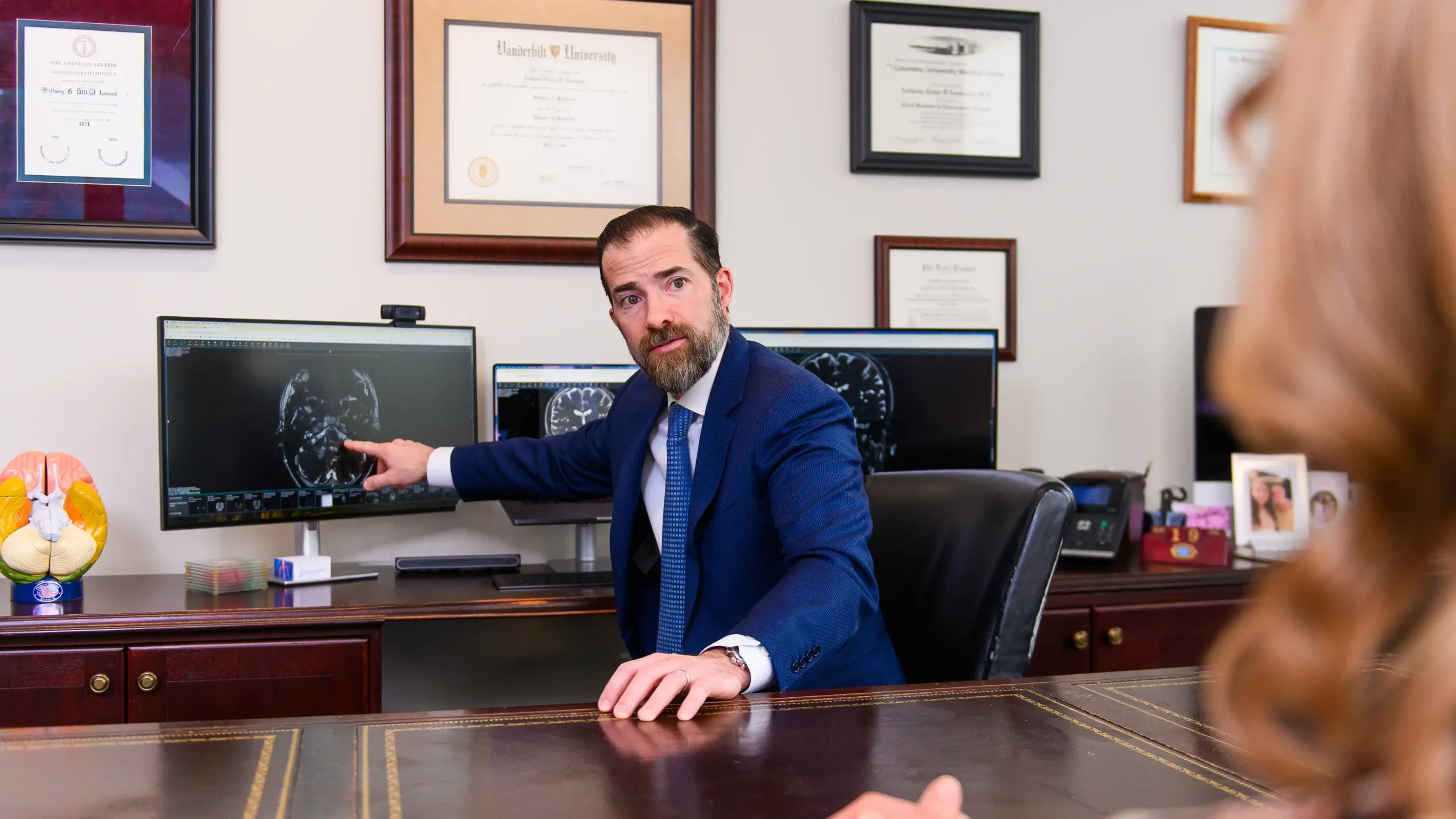
Before surgery, detailed MRI imaging helps confirm whether vascular compression is present. Because the procedure involves delicate structures near the brainstem, experience with cranial nerve disorders matters. Not every patient needs surgery, and a consultation is not a commitment to it.
Are you out of options
to eliminate your pain?
Botox for Hemifacial Spasm: Effective Symptom Management
Botox works by temporarily relaxing the muscles affected by abnormal nerve signals. It doesn’t stop the nerve irritation itself. It reduces the muscle contractions that cause visible twitching.
Botox remains one of the most commonly used hemifacial spasm treatment options. Many patients get meaningful relief and can go about daily life with fewer interruptions. Most need repeat treatments every three to four months.
Botox controls symptoms but it won’t cure hemifacial spasm. The nerve compression stays unchanged, so symptoms return when the injection wears off. Over time, many patients notice the relief becoming less predictable or wearing off sooner than expected.
Many patients are happy with Botox for years and appreciate the flexibility it provides. Others eventually consider whether a treatment that addresses the underlying nerve compression may be right for them. If symptoms change or injections become less effective, discussing all available options with a specialist can help guide the next step.
Medications: What They Can and Can’t Do
Medications are another hemifacial spasm treatment option and are often used early in the course of treatment. Certain medicines, including muscle relaxants and anticonvulsants, may reduce how often or how strongly the muscles contract.
Rarely, oral medication provides enough relief to avoid more invasive treatment. But results vary widely. Medications don’t fix the underlying problem.
If a blood vessel presses on the facial nerve, medication can’t remove that pressure. Side effects like fatigue, dizziness, or difficulty concentrating can also make long-term use difficult.
Which Treatment Option Is Right for You?
Your symptoms and your goals drive the treatment decision. Every patient is different.
Some patients choose MVD because they want to address the underlying nerve compression. Others find that Botox provides meaningful symptom control for many years, while some prefer medications or a combination of treatments. The right approach depends on your symptoms, imaging results, and personal goals.
At Neurosurgeons of New Jersey, a consultation is a conversation, not a commitment to surgery. The goal is to help you understand the full picture, including the benefits and limits of every option available.
You have choices. You don’t have to stay on a cycle of Botox injections. If your symptoms are affecting your quality of life and you want answers, our specialists are here to help. Book a consultation at Neurosurgeons of New Jersey.
Frequently Asked Questions
What is the latest treatment for hemifacial spasm?
No single new therapy has changed everything. But better imaging, more precise surgery, and smarter patient matching have helped more patients get better results.
Does Botox cure hemifacial spasm?
No. Botox eases symptoms but does not fix the nerve problem driving them.
What happens if Botox stops working?
You may want to discuss other hemifacial spasm treatment options with your doctor. For people with confirmed vascular compression, microvascular decompression surgery is worth considering.
Who is a good candidate for MVD?
Good candidates still have symptoms after trying other treatments, and their MRI shows a blood vessel touching their facial nerve. A neurosurgeon who specializes in microvascular decompression surgery can help determine whether MVD is appropriate for your specific situation.
Where can I find a hemifacial spasm specialist in New Jersey?
Neurosurgeons of New Jersey offers specialized evaluation and treatment for cranial nerve disorders, with award-winning expertise in treating hemifacial spasm and other facial nerve conditions. Request a consultation to learn more about your treatment options.
About Dr. Anthony D'Ambrosio
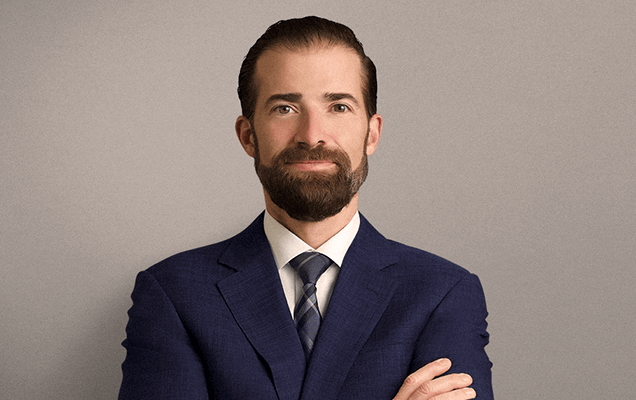
Dr. Anthony D'Ambrosio is an accomplished neurosurgeon in North Jersey and a proud member of Neurosurgeons of New Jersey practicing primarily out of their Ridgewood office conveniently located on East Ridgewood Avenue. Dr. D’Ambrosio focuses his clinical practice on brain tumors, nervous system disorders, and facial pain disorders. He has expertise in a variety of complex surgical and radiosurgical techniques as well as minimally invasive procedures intended to successfully treat complex diseases of the brain. These techniques include micro-neurosurgery, microvascular decompression surgery and Gamma Knife radiosurgery. He's authored over 25 peer-reviewed journals and is the recipient of many awards.


Please call today to schedule a consultation with me.
(551) 284-3265
Request a consultation with Dr. D'Ambrosio