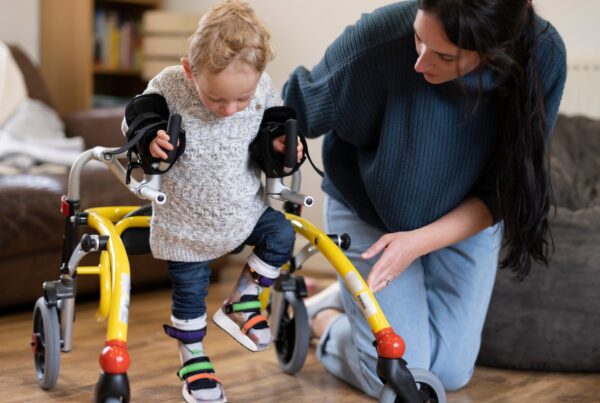


Selective dorsal rhizotomy, or SDR, may be an option for some children with spastic cerebral palsy whose muscle tightness affects movement or comfort. Specialists assess strength, movement control, treatment history, goals, and rehabilitation needs to determine whether SDR could help. An individual evaluation is needed because cerebral palsy affects every child differently.
When you are considering surgery for your child, hope and worry can sit side by side. You may be hoping for less pain or easier movement while wondering, “What if this is not right for my child?” It can be hard to sort through those feelings alongside unfamiliar medical terms and other families’ stories. You do not need to arrive at a consultation feeling certain or knowing all the right questions.
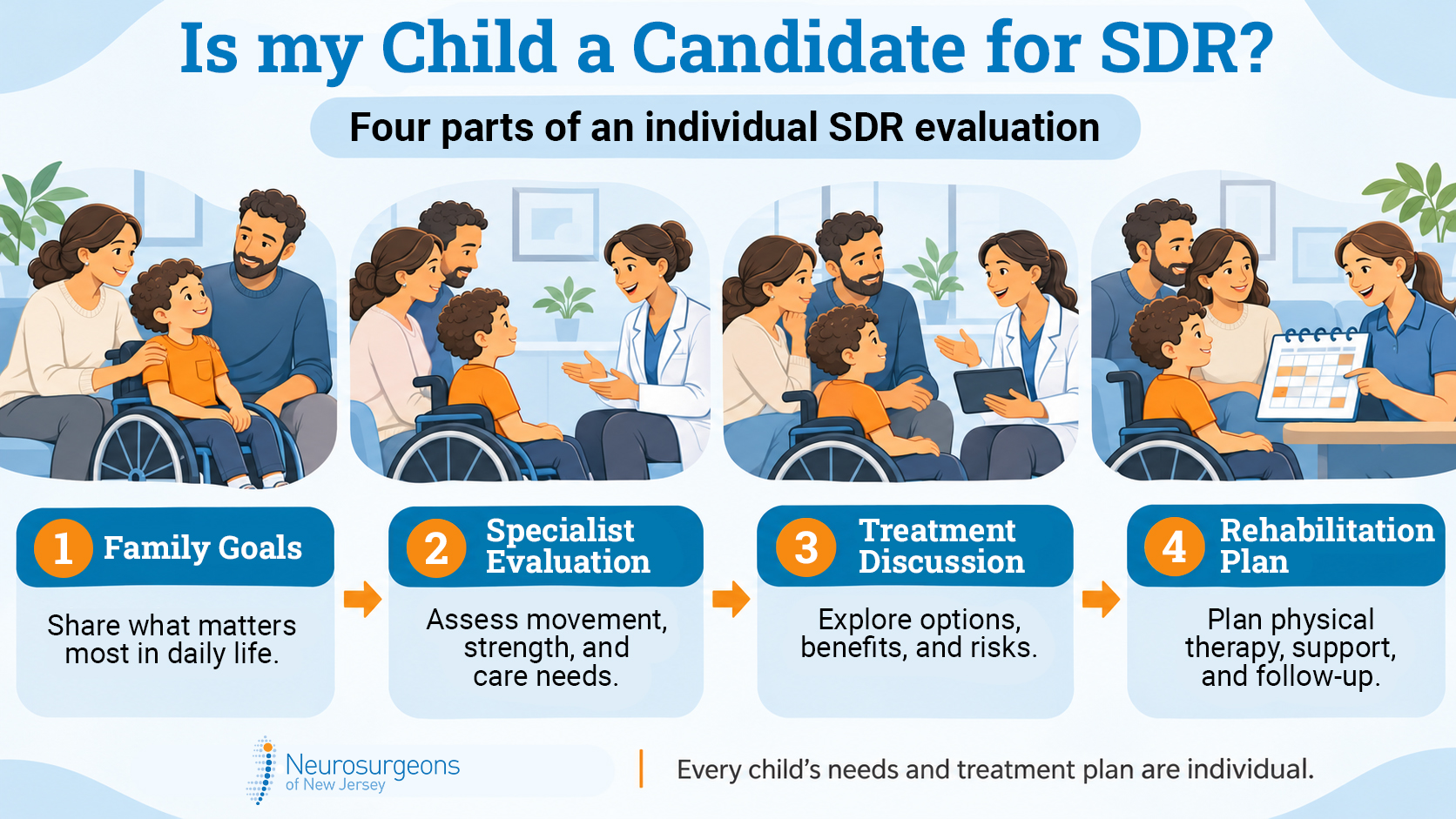
“Is my child a candidate?” is a reasonable place to start. Another helpful question is, “What would we like treatment to change in my child’s daily life?” This guide walks through four parts of that conversation: family goals, specialist evaluation, treatment options, and rehabilitation. An evaluation gives you a place to explore the choices before making a decision.
What Is Selective Dorsal Rhizotomy for Cerebral Palsy?
Spasticity causes muscles to tighten more than they should. In children with cerebral palsy, it can make movement harder and contribute to discomfort. SDR is surgery that reduces spasticity, usually in the legs, by cutting selected sensory nerve rootlets in the lower spine.
SDR does not cure cerebral palsy or address every cause of movement difficulty. A child may also have weakness, balance challenges, or joints with limited movement. Reducing spasticity does not guarantee independent walking or remove the need for other care.
Richard C.E. Anderson, MD, FACS, FAAP, pediatric neurosurgeon at Neurosurgeons of New Jersey, emphasizes an individual approach:
“Cerebral palsy affects every child differently, so treatment should always be individualized. For children whose mobility or comfort is affected by spasticity, selective dorsal rhizotomy may be one option to consider. Awareness is important because families should know that specialized treatments are available and that an evaluation with an experienced care team can help determine the right path forward.”
Step 1 Start With Your Child’s and Family’s Goals
You see the effort behind everyday moments that others may not notice: getting dressed, moving between rooms, or joining friends at school. Before the consultation, think about which of those moments you and your child would most like to make easier. Does your child want to move around school with less effort? Is stiffness making dressing uncomfortable, or are transfers between a wheelchair and bed difficult?
Write down two or three priorities, using everyday examples. “Getting to the cafeteria without becoming so tired” gives the team a clearer starting point than “better mobility.” Ask your child what matters to them, using the way they communicate best.
Walking is one possible goal. Comfort, positioning, and ease of care may also shape the conversation for some children. Those goals can lead to different treatment recommendations, so ask what benefits the team considers realistic for your child.
Step 2 Understand How Specialists Evaluate SDR Candidacy
An SDR evaluation looks beyond how tight the muscles feel. Specialists review a child’s medical history, previous treatments, movement, and current abilities. Dr. Anderson works with an interdisciplinary team involved in care before, during, and after surgery. Physical therapy assessments help connect the treatment discussion to how your child moves in daily life.
What Is Making Movement Difficult
The team may examine muscle tone, strength, joint movement, and the ability to control individual movements. They may observe sitting, transfers, or walking, with the child’s usual equipment as appropriate. These findings help separate spasticity from other barriers to movement.
For example, a joint that cannot fully straighten may have a fixed contracture, meaning muscles or other tissues have shortened. Dystonia, which can cause twisting movements or changing muscle tone, also requires a different assessment. SDR targets spasticity, so the team needs to understand which problems are most important.
What Makes a Child a Candidate for SDR?
Underlying strength and movement control matter. Some children use muscle stiffness to help support themselves, so reducing it could expose weakness. Specialists also consider the child’s ability to take part in rehabilitation and the support available for that care.
The assessment may include imaging, a physical therapy evaluation, or a detailed study of walking. The exact tests depend on the child and the treatment program. Age ranges and selection criteria vary across centers, so an online checklist cannot replace an individual evaluation.
How a Baclofen Trial Can Help Guide the Conversation
As part of his evaluation process, Dr. Anderson may use an intrathecal baclofen trial. A test dose of baclofen, a medicine that reduces muscle tightness, is delivered through a lumbar puncture into the fluid surrounding the spinal cord. The effect is temporary, allowing the team to assess changes as spasticity decreases.
A physical therapist assesses your child before the injection and repeats assessments afterward. Comparing those findings can help the team and your family discuss how reduced tightness affects movement and which goals may be realistic. Ask what changes the team observed and what those findings mean for your child.
The trial does not reproduce SDR surgery or guarantee a surgical result. It provides additional information for the treatment discussion. Ask Dr. Anderson whether the trial is appropriate for your child, what risks it carries, and how the results would shape his recommendation.
An evaluation can feel like a lot to take in, especially when you are hearing new terms or trying to remember several recommendations. Ask the team to explain what each finding means for your child, and ask again if something is unclear. You can write down questions as they come up or bring someone who can help take notes. The goal is to understand the recommendation well enough to weigh it against what matters to your family.
Step 3 Compare SDR With Other Spasticity Treatments
A balanced treatment discussion includes the options that match your child’s needs. Physical therapy, braces, medicines, and botulinum toxin injections may be part of care. For some children, specialists may discuss a baclofen pump, which delivers medicine into the spinal fluid, or orthopedic surgery to address muscle, tendon, or bone problems.
These treatments serve different purposes. Ask which problem each option would address, what benefit is expected, and how the team would know whether it is helping. Also ask whether treatments might be used together or at different points as your child grows.
SDR is irreversible. Before deciding, families should understand its risks and the uncertainty around individual long-term outcomes. The discussion should cover possible complications such as infection, bleeding, spinal fluid leakage, changes in sensation, weakness, and bladder or bowel problems.
Hearing about surgical risks can be frightening, even when you want to understand them. Ask which risks apply to your child and the proposed surgical approach, and what the plan would be if the improvement were smaller than hoped. It is okay to say, “This is the part that worries me most,” or to ask for an explanation in everyday language. Ask how much time you have to consider the recommendation and whether a second opinion would be helpful.
Step 4 Understand Rehabilitation After SDR Surgery
Rehabilitation is a central part of SDR treatment. After spasticity is reduced, muscles may feel looser and weaker. Therapy helps children build strength and practice movement with less stiffness. The plan may include work on balance, transfers, standing, or walking, depending on the child’s goals.
Recovery involves more than the hospital stay. Families may need frequent therapy visits and exercises at home over many months. Some children need inpatient rehabilitation, while others follow a different schedule. Ask for the plan recommended for your child rather than relying on another family’s timeline.
Discuss the practical details early: who will provide therapy, how appointments will fit around school, and what insurance will cover. Ask whether equipment or braces may change and who will coordinate care with your child’s local therapist.
The thought of months of therapy may feel overwhelming, especially if your family is already balancing appointments, work, school, and care for other children. If transportation, cost, or scheduling is a concern, tell the team early. These are real parts of the treatment decision, and raising them helps identify what support you would need. Ask for a plan that explains both your child’s rehabilitation needs and how that care could fit into your family’s life.
Questions to Bring to an SDR Consultation
It can be hard to remember every question when you are worried or taking in a lot of information. Save or print this checklist, add your child’s questions, and mark the topics that matter most to your family. You can use it to guide the conversation and write down anything you want to revisit.
- How much of my child’s difficulty comes from spasticity rather than weakness, dystonia, or joint changes?
- Which of our goals could SDR reasonably help, and which are less likely to change?
- Would an intrathecal baclofen trial help evaluate my child, and what could it tell us about realistic goals?
- What other treatments fit my child’s needs, and why?
- What are the benefits, limitations, and risks of SDR for my child?
- Could my child still need braces, a mobility device, medicine, or orthopedic surgery?
- What would rehabilitation involve, and who would coordinate it?
- What support is available for therapy access, transportation, school planning, or insurance questions?
- How will you measure progress, and what happens if the outcome differs from the plan?
Schedule an SDR Evaluation in New Jersey
You do not have to decide on surgery before taking the first step. A consultation is a chance to share what daily life is like for your child, talk about your hopes and concerns, and understand what an evaluation may involve. Ask the office which records to bring; a medication list, therapy reports, and information about prior treatments can help. Bring your questions, too, including the ones that feel difficult to ask.
At Neurosurgeons of New Jersey, Dr. Anderson evaluates children with conditions that may benefit from pediatric neurosurgical care, including SDR. If you are wondering whether an SDR evaluation could help your child, request a consultation with Dr. Anderson. You can begin with questions rather than a decision, and work toward a plan that reflects your child’s needs and your family’s priorities.
Frequently Asked Questions
Can SDR Cure Cerebral Palsy?
No. SDR treats spasticity, one feature of cerebral palsy. Your child may still need therapy, equipment, or other treatments, and the care team can explain which needs surgery may or may not change.
Does My Child Need to Walk to Be Evaluated?
Not necessarily. Some specialist programs consider selected children who do not walk when the goal is comfort, positioning, or easier care. The team must assess whether SDR or another treatment best fits those goals.
What Is the Best Age for SDR Surgery?
There is no single age that makes a child a candidate for SDR. Timing depends on the child’s strength, movement, health, and readiness for rehabilitation, and selection criteria vary among programs. Ask the team whether an evaluation now would help guide treatment planning.
Does My Child Need to Try Other Treatments First?
The team reviews how your child has responded to therapy, medicines, braces, or injections. SDR may be considered when other treatments do not provide enough relief, but families should not use a rigid treatment checklist to decide on their own. Ask which options fit your child and why.
When Might Another Treatment Be More Appropriate?
Significant weakness, prominent dystonia, or fixed joint changes may affect whether SDR can meet your child’s goals. These findings do not all mean the same thing: some may point toward another treatment, while others may require care alongside SDR. Ask which problem each recommended treatment would address.
How Long Does Rehabilitation After SDR Take?
Rehabilitation commonly extends over many months, and continued therapy may be needed beyond the first year. Your child’s team should explain the expected schedule, goals, and follow-up before surgery.
What if My Child Is Not a Candidate for SDR?
Ask the team which treatments or next assessments they recommend and why. An evaluation can still help you understand your child’s needs and plan the next step in care.
It's time to get back
to doing what you love.
About Dr. Richard C.E. Anderson, MD, FACS, FAAP
Dr. Richard Anderson is recognized as one of the top, award-winning pediatric neurosurgeons in the Tri-State region. He practices out of Neurosurgeons of New Jersey’s Central and North Jersey locations, including the Ridgewood, Morristown, Manhattan, and Paterson offices. Utilizing the most innovative and proven technology, Dr. Anderson specializes in the treatment of pediatric brain and spinal disorders through minimally invasive surgeries and complex procedures when necessary. With over 250 publications, invited lectures, TV, and magazine interviews, Dr. Anderson is consistently named one of America’s Top Doctors, America’s Top Surgeons, Favorite Kids’ Doctors in NJ, and a recipient of the Patient’s Choice Award. He is currently accepting new patients.

About Dr. Richard C.E. Anderson
Dr. Richard Anderson is recognized as one of the top, award-winning pediatric neurosurgeons in the Tri-State region. He practices out of Neurosurgeons of New Jersey's Central and North Jersey locations including the Ridgewood, Livingston and Paterson offices. Utilizing the most innovative, proven technology, Dr. Anderson specializes in the treatment of pediatric brain and spinal disorders by means of minimally invasive surgeries and complex surgeries when appropriate. With over 250 publications, invited lectures, TV, and magazine interviews, Dr. Anderson is consistently named one of America’s Top Doctors, America’s Top Surgeons, Favorite Kid’s Doctors in NJ, and recipient of Patient’s Choice Award. He is currently accepting new patients.
Recent Posts: