
Microvascular Decompression – MVD – Overview
A step-by-step guide from consultation to recovery, so you know exactly what’s ahead.
If you’ve been living with the involuntary muscle contractions of hemifacial spasm or the electric, shock-like pain of trigeminal neuralgia, you already know how much it can take over your daily life. When other treatments haven’t provided lasting relief, microvascular decompression is a surgical option worth understanding fully.
This guide walks you through the procedure from start to finish, so you can approach your surgery with clarity rather than uncertainty.
What Is Microvascular Decompression?
Microvascular decompression, also called MVD, is a surgical procedure designed to relieve pressure on a cranial nerve caused by a nearby blood vessel. The blood vessel isn’t broken or diseased. It’s simply resting too close to an important nerve, and that contact causes the nerve to become overactive. When that happens, it fires signals when it shouldn’t.
The solution is straightforward. During MVD surgery, one or more small Teflon sponges are carefully placed between the nerve and the blood vessel, cushioning the contact point and calming the nerve down. Think of it the way insulation protects a wire, or the way a pillow protects your head at night. The surgeon isn’t removing or destroying anything. The goal is protection.
MVD is just one of several treatment options for cranial nerve conditions like hemifacial spasm and trigeminal neuralgia. Other options include gamma knife radiosurgery, percutaneous rhizotomy, pain stimulation, injections, and continued medication management. That said, MVD is the only surgical approach that addresses the physical source of the problem directly, without applying heat or pressure to the nerve itself. That’s why symptom recurrence tends to be lower with MVD than with several alternative procedures.
One important note for patients with multiple sclerosis: MVD can be considered in MS-related trigeminal neuralgia, but only after a multidisciplinary team has reviewed the case thoroughly.
In the Operating Room
Microvascular decompression is performed under general anesthesia. Once you’re sedated, your surgeon makes a small opening behind your ear, roughly the size of a quarter. Through that opening, the surgeon locates the appropriate nerve and the blood vessel that is pressing on it.
At the point of contact, one or more Teflon sponges are carefully placed between the nerve and the vessel. A small cranioplasty is then fitted precisely into place, the skin is sutured, and a small bandage is applied.
From the time you go under anesthesia to the time you wake up, the procedure typically lasts between two to three hours.
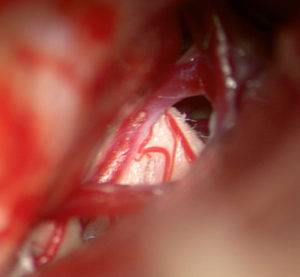
Microvascular decompression – Image from the operating room after the teflon sponge is placed under the vessels.
In the Recovery Room
After surgery, you’ll move to a recovery area where your care team monitors your vital signs closely as the anesthesia wears off. Intravenous pain medication begins here to keep you comfortable during the early stages of recovery. Most patients spend one to two hours in the recovery room, though you may not recall all of that time given the transition out of sedation.
In the Neuro ICU
Many patients spend their first night in the Neuro ICU as a precautionary measure. This allows for close monitoring and attentive care during the initial recovery period. Some pain around the incision site and mild nausea are both normal at this stage. Both are managed with intravenous medications.
Most patients in the Neuro ICU are sitting up and having dinner with family by the evening of their surgery. Vital signs and the effectiveness of pain and nausea management continue to be tracked throughout the night.
The Rest of Your Hospital Stay
The morning after surgery, you’ll be transferred to a regular hospital room where nurses and therapists help you sit up, get out of bed, walk, and manage basic daily activity. The clinical benchmarks your team watches for at this stage are straightforward: eating comfortably, managing pain with oral medication rather than IV, and walking without difficulty.
Most patients leave the hospital two to three days after surgery, including the day of the procedure. If other health factors complicate recovery, the stay may be longer.
Are you out of options
to eliminate your pain?
Recovering at Home
The first several days at home often involve some fatigue, soreness, and general weakness. That’s normal, and it passes. Most patients feel better than they expected fairly quickly after MVD surgery.
A few practical guidelines for the weeks following discharge:
- You can wash your hair 72 hours after surgery
- Everyday tasks around the house are generally fine
- Driving can resume around seven days post-surgery
- Heavy lifting is not permitted until six weeks after the procedure
Your surgeon will typically see you back in the office around seven days after surgery to check the incision and assess how you’re feeling. If the facial pain or spasm has resolved, medications can be gradually tapered over the following weeks under your surgeon’s guidance.
Including the hospital stay, full microvascular decompression recovery spans roughly two to four weeks for most patients, with steady improvement along the way. The most important things you can do during that time are rest appropriately, follow your surgeon’s plan, and give yourself permission to heal at a reasonable pace.
Mild pain, and some fatigue in the first week is common. Once those issues ease, most patients find themselves able to fully appreciate what relief from chronic facial pain or spasm actually feels like.
Is It Time to Explore Your Options?
Living with hemifacial spasm or trigeminal neuralgia is exhausting in a way that’s hard to explain to anyone who hasn’t experienced it. If you’ve reached the point where other treatments aren’t providing the relief you need, microvascular decompression is worth a closer look.
The specialists at Neurosurgeons of New Jersey have extensive experience evaluating and treating cranial nerve conditions, and every conversation starts with your symptoms, your history, and what matters most to you.
Schedule a consultation today and take the first step toward lasting relief.
Frequently Asked Questions
Is microvascular decompression a major surgery?
MVD is a significant procedure performed under general anesthesia that requires a short hospital stay and a recovery period of two to four weeks. That said, it’s a well-established surgery with a strong track record for hemifacial spasm and trigeminal neuralgia when performed by an experienced neurosurgeon.
How successful is MVD for hemifacial spasms?
Microvascular decompression (MVD) is generally considered one of the most effective treatments for hemifacial spasm, especially when symptoms are caused by pressure on the facial nerve. Many patients experience meaningful relief after surgery, sometimes right away and sometimes gradually as the nerve heals. A neurosurgeon can help determine what kind of results you can expect based on your specific condition.
How successful is MVD for trigeminal neuralgia?
MVD has one of the highest long-term success rates among surgical treatments for trigeminal neuralgia. Because it addresses the physical source of the problem rather than the nerve itself, pain recurrence rates tend to be lower than with many alternative procedures.
Will MVD cause facial numbness?
Unlike some other surgical options for trigeminal neuralgia, facial numbness is generally not a common side effect of MVD, but it is possible. Your surgeon will discuss the specific risks associated with your case before any decisions are made.
When can I return to normal activity after MVD surgery?
Most patients return to light daily activity within one to two weeks. Driving is typically permitted around seven days after surgery. Heavy lifting and strenuous activity are restricted until six weeks post-operation.
Is MVD an option if I have multiple sclerosis?
It can be, but MS-related trigeminal neuralgia requires careful evaluation by a multidisciplinary team before MVD is recommended. Your care team will review your full history before determining whether surgery is appropriate.

About Dr. Anthony D'Ambrosio
Dr. Anthony D'Ambrosio is an accomplished neurosurgeon in North Jersey and a proud member of Neurosurgeons of New Jersey practicing primarily out of their Ridgewood office conveniently located on East Ridgewood Avenue. Dr. D’Ambrosio focuses his clinical practice on brain tumors, nervous system disorders, and facial pain disorders. He has expertise in a variety of complex surgical and radiosurgical techniques as well as minimally invasive procedures intended to successfully treat complex diseases of the brain. These techniques include micro-neurosurgery, microvascular decompression surgery and Gamma Knife radiosurgery. He's authored over 25 peer-reviewed journals and is the recipient of many awards.