
A lumbar herniated disc is one of the most common reasons for sharp pain that starts in the lower back and travels down one leg. People often call it a slipped or ruptured disc, and the pain can flare when you sit, bend forward, or even cough. If you’ve just seen the words “disc herniation” on an MRI report, it’s natural to wonder what comes next.
The reassuring news is that most people improve without surgery, often within a few months. This guide explains what lumbar herniated disc symptoms feel like, which warning signs need emergency care, how doctors confirm the diagnosis, and how our neurosurgeons decide when more than rest and therapy may help.
What Is a Lumbar Herniated Disc?
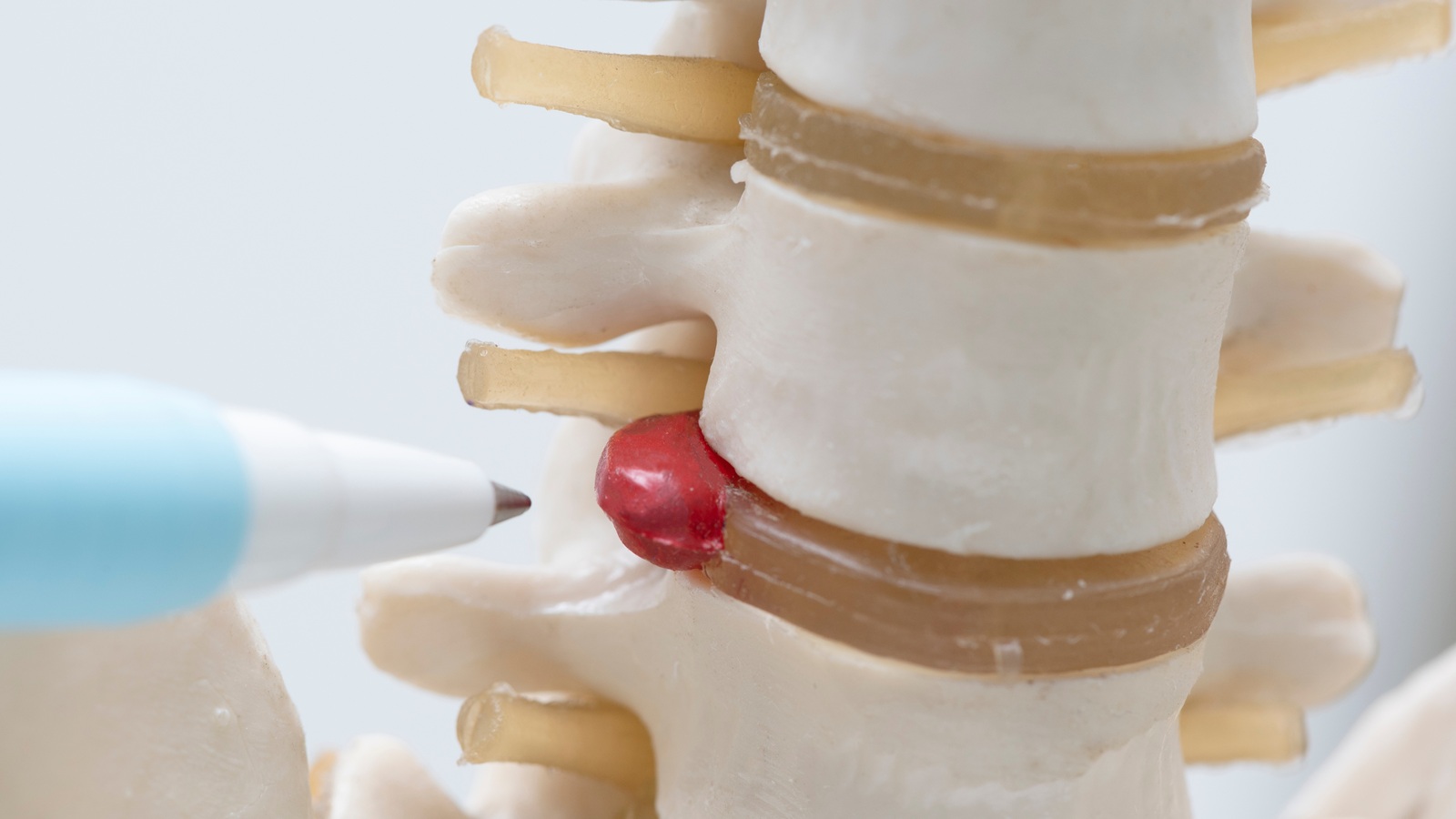
Your spine is made of bones called vertebrae, and the five in your lower back form your lumbar spine. Between each pair sits a disc, a rubbery cushion that absorbs shock when you move. Each disc has a tough outer ring and a soft, gel-like center. A herniation happens when part of that soft center pushes through a tear in the outer ring and presses on a nearby nerve, which can cause pain, numbness, or weakness.
Symptomatic disc herniations are less common than many people think. According to consensus recommendations from the World Federation of Neurosurgical Societies (WFNS) Spine Committee, the lifetime risk of a lumbar disc herniation that causes symptoms is about 1 to 3%. Of those, 60 to 90% improve on their own without surgery.
What Your MRI Report Means: Bulge, Protrusion, Extrusion, or Sequestration
Radiologists use specific terms to describe how far disc material has moved. A bulge extends evenly past the disc’s normal edge, and a protrusion pushes out a small section that the outer ring still holds in. An extrusion means material has broken through the outer ring, and a sequestration means a piece has separated and moved away from the disc. These labels describe what the scan shows, but they don’t tell the whole story on their own.
A herniated disc on an MRI doesn’t always explain your pain. Many people have disc herniations that cause no symptoms at all and only learn about them from a scan done for another reason. That’s why your doctor looks at how your symptoms, exam, and imaging fit together before recommending treatment.
When a Herniated Disc Needs Emergency Care
In rare cases, a large herniation presses on the cauda equina, the bundle of nerve roots at the bottom of your spinal canal. This condition, called cauda equina syndrome, is a medical emergency. Go to the nearest emergency room right away if you develop any of these signs:
- New trouble controlling or emptying your bladder, or loss of bowel control
- Numbness in your groin, inner thighs, or buttocks (the “saddle” area)
- Leg weakness that gets worse quickly or affects both legs
Fast treatment matters because the chance of recovering nerve function depends on how quickly pressure on the nerves is relieved. Don’t wait for a scheduled appointment if you notice any of these symptoms.
It's time to get back
to doing what you love.
What Causes a Lumbar Disc to Herniate?
Most herniated discs develop from gradual wear rather than one dramatic injury. As you age, discs lose water and become less flexible, so small tears form more easily. Lifting while twisting, strenuous physical work, smoking, and extra body weight can all add stress to your discs. Genetics also play a role, since disc problems tend to run in families. Often no single cause stands out, and a herniated disc is not a sign that you did something wrong.
How Doctors Diagnose a Herniated Disc
Diagnosis starts with a conversation about your symptoms and a hands-on exam. Your doctor checks your reflexes, muscle strength, and feeling in your legs and feet. A common test is the straight leg raise, where your doctor slowly lifts your leg while you lie on your back. According to the American Academy of Orthopaedic Surgeons, pain that travels below the knee during this test strongly suggests a herniated disc.
MRI is the most useful imaging test because it shows discs and nerves in clear detail, and the WFNS Spine Committee considers it the gold standard for confirming a suspected herniation. An MRI isn’t always needed right away, especially when symptoms are mild or improving. In some cases, your doctor may order an electromyography (EMG) test to check how well your nerves and muscles are working together.
If you aren’t sure where to start, a Neuro-Spine First evaluation offers a nerve-focused consultation with appointments available within 24 to 48 hours. Afterward, you receive a Neuro-Spine First Evaluation Report that summarizes what your nerve expert found and outlines possible next steps. Starting with an evaluation doesn’t mean you need surgery.
Lumbar Herniated Disc Treatment Options
For most people, time is one of the most effective treatments. A 2024 review in Deutsches Ärzteblatt International reported that symptoms resolve within 6 to 12 weeks in 60 to 80% of patients, and 80 to 90% improve over the long term. The body can also shrink or reabsorb herniated disc material on its own. A 2024 systematic review found this often happens within 3 to 6 months, and a 2023 meta-analysis in the Journal of Neurosurgery: Spine found that larger fragments that break free tend to shrink the most, though results vary. For a closer look at how care usually progresses, see our step-by-step treatment timeline.
Nonsurgical Treatment
Most treatment plans begin with nonsurgical care that calms the irritated nerve while your body heals. Your doctor may recommend a short period of modified activity, avoiding movements that flare your pain, rather than long stretches of bed rest. Anti-inflammatory medicines such as ibuprofen can help with mild to moderate pain, and some people benefit from prescription medicine for nerve pain. Physical therapy can help you move more comfortably and strengthen the muscles that support your spine. If pain stays severe, an epidural steroid injection, which places anti-inflammatory medicine near the irritated nerve, may provide short-term relief.
When Surgery May Help
Surgery is usually considered when significant pain continues after about 6 to 12 weeks of nonsurgical care, or sooner when leg weakness is severe or getting worse. Cauda equina syndrome requires urgent surgery. Even so, the WFNS Spine Committee notes that fewer than 10% of people with a lumbar disc herniation are candidates for surgery.
The most common procedure for a single herniated disc is a microdiscectomy. During this surgery, your surgeon removes only the piece of disc pressing on the nerve and leaves the healthy disc in place. With a minimally invasive lumbar microdiscectomy, the surgeon works through a small incision, and many patients go home the same day. Like any surgery, microdiscectomy carries risks, including infection, bleeding, nerve injury, and a tear in the protective lining around the nerves. The disc can also herniate again, which the WFNS Spine Committee estimates happens in about 5% of patients after surgery.
The spine team at Neurosurgeons of New Jersey review each patient’s symptoms, exam, and imaging to decide whether surgery is likely to help and which approach fits best. Your surgeon will also walk you through the lumbar discectomy recovery timeline so you know what to expect before you decide.
Living With a Herniated Disc Day to Day
Small changes to your daily routine can make the healing period easier to manage. Staying gently active usually helps more than resting in bed, so walk as much as you comfortably can and get up from your chair often. When you lift, bend your knees and keep objects close to your body. Heat or ice can ease soreness, and many people sleep more comfortably on their back with a pillow under their knees or on their side with a pillow between their legs.
Over the long term, building core strength, keeping a healthy weight, and quitting smoking may help lower the strain on your discs. Your doctor or physical therapist can suggest exercises that are safe for your stage of recovery. If a movement sharply increases your leg pain, stop and check with your care team before continuing.
Getting Clear Answers About Your Herniated Disc
A lumbar herniated disc can make it hard to sit through a meeting, sleep through the night, or enjoy time with family. The encouraging reality is that most people improve with time and nonsurgical care, and surgery is reserved for those whose symptoms don’t improve or who show signs of nerve damage. The most important step is getting an accurate explanation of what your scan means and which options fit your life.
Our spine neurosurgeons see patients at offices across New Jersey. We’ll review your symptoms and imaging, explain your results in plain language, and recommend surgery only when it’s likely to help.
Request a consultation or call 551-284-3265 to talk with our team about your next step.
Frequently Asked Questions
How long does a lumbar herniated disc take to heal?
Many people feel noticeably better within 6 to 12 weeks, and most keep improving over the following months. Research shows that herniated disc material often shrinks on its own within about 3 to 6 months. Numbness or weakness can take longer to fade than pain does. Your recovery depends on the size and location of the herniation, your overall health, and how you respond to treatment, so your doctor can give you a more personal estimate.
Can a herniated disc heal on its own?
Yes, in many cases. The body can gradually break down and reabsorb disc material that has pushed out of place, which relieves pressure on the nerve. Studies suggest that larger fragments that break free may actually shrink the most. Nonsurgical care such as activity changes, medicine, and physical therapy helps manage pain while this happens. If symptoms don’t improve after several weeks, or if you develop weakness, a specialist can help decide whether you need more treatment.
Do I need surgery for a herniated disc in my lower back?
Most people don’t. Fewer than 1 in 10 people with a lumbar disc herniation become candidates for surgery, according to the WFNS Spine Committee. Surgery may be considered if severe pain lasts beyond about 6 to 12 weeks of nonsurgical care, if leg weakness is getting worse, or if you develop signs of cauda equina syndrome, which needs emergency care. A neurosurgeon can review your symptoms and imaging to help you weigh the benefits and risks.
What if my MRI shows a herniated disc but I have no pain?
That’s common and usually not a cause for concern. Many people have disc herniations that never cause symptoms and are found only on scans done for other reasons. Treatment is based on your symptoms and exam, not on the MRI alone. If you later develop back pain, leg pain, numbness, or weakness, let your doctor know so they can compare your symptoms with your imaging.
Is walking good for a herniated disc?
For most people, yes. Gentle walking keeps you moving without placing heavy strain on your spine, and staying active is generally better than long periods of bed rest. Start with short walks on flat ground and add distance as you feel able. If walking causes sharp or worsening leg pain, numbness, or weakness, slow down and talk with your doctor about adjusting your activity.
Author of this Blog:
Dr. Alfred T. Ogden, MD, FAANS

About Dr. Alfred T. Ogden
Dr. Alfred T. Ogden is an accomplished neurosurgeon in North Jersey and is a proud member of Neurosurgeons of New Jersey, practicing out of their Ridgewood office conveniently located on East Ridgewood Avenue. Dr. Ogden is internationally recognized as a leader in minimally invasive spine surgery.