
When back or neck pain stops responding to conservative treatment, surgery eventually enters the conversation. For most patients, that moment brings as many questions as it does relief, because suddenly you’re weighing options you’ve never had to think about before.
Artificial disc replacement and spinal fusion are the two procedures that come up most often at this stage. Both can significantly reduce pain and restore function, but they work differently, suit different patients, and carry different implications for how your spine moves long after you’ve recovered. Understanding those differences is worth your time before you sit down with a surgeon.
What Is Artificial Disc Replacement?
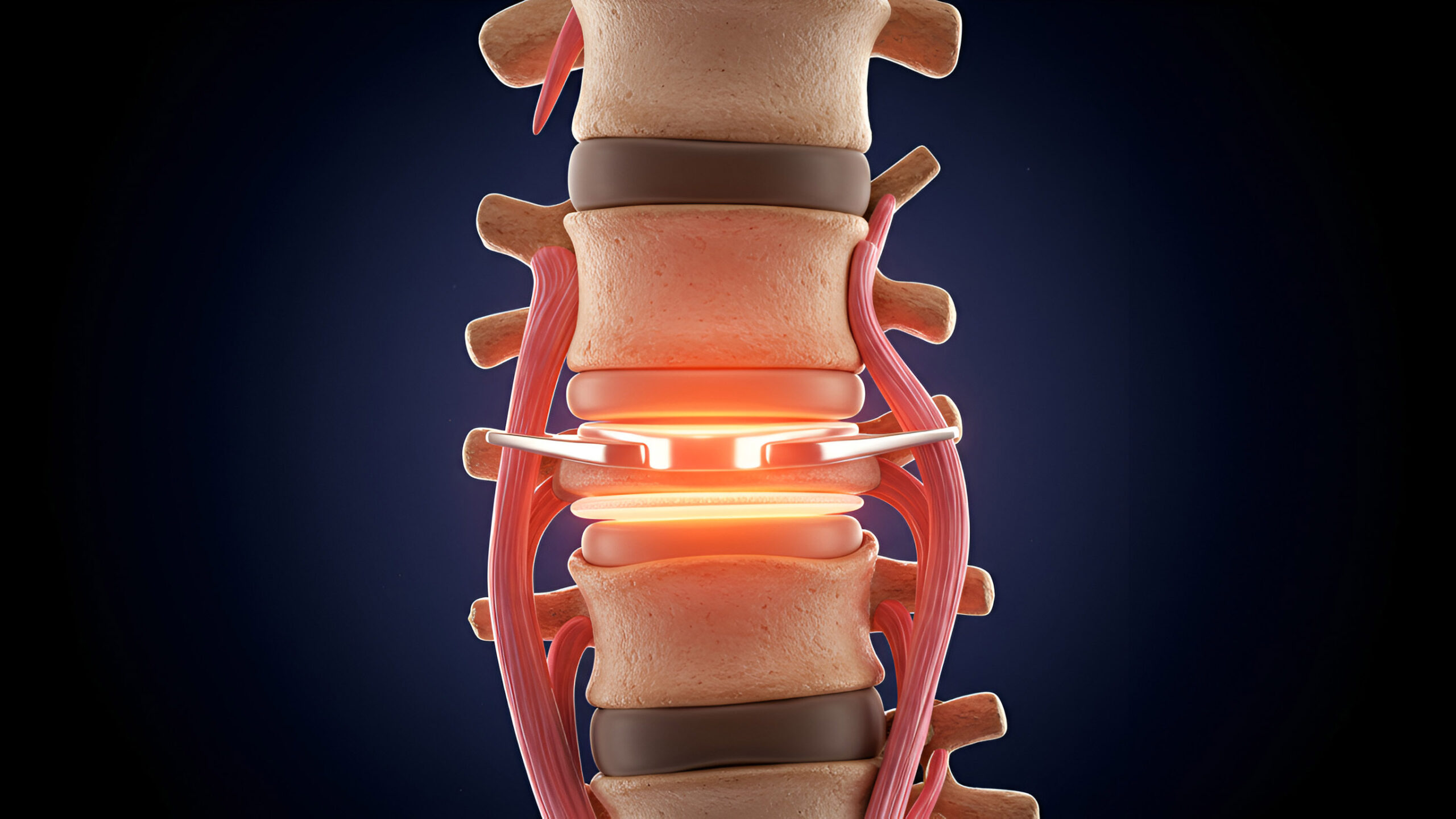
A damaged spinal disc acts a lot like a worn-out shock absorber. It stops doing its job and starts causing problems for everything around it. Artificial disc replacement removes that disc and replaces it with a small implant engineered to replicate how a healthy disc moves.
The keyword is moves. Unlike fusion, this procedure doesn’t eliminate motion at the treated segment; it restores it. That matters because keeping natural movement at one level takes pressure off the discs above and below it, which can play a meaningful role in the long-term health of your spine.
Disc replacement tends to work best for patients whose pain comes from a single damaged disc, whose surrounding spine is otherwise stable and healthy, and who want to preserve as much natural flexibility as possible.
What Is Spinal Fusion?
Spinal fusion takes a different approach entirely. Rather than replacing a damaged disc, fusion connects the vertebrae on either side of the problem area so they eventually grow into one solid unit. Motion at that segment stops, and with it, often the pain that instability or severe degeneration was causing.
This procedure has decades of data behind it and remains the standard of care for a wide range of spine conditions. It’s particularly well-suited for patients dealing with structural instability, deformity like scoliosis, advanced degeneration across multiple levels, or damage that goes beyond what a single disc replacement can address.
The Core Difference
Everything comes down to this: artificial disc replacement preserves motion, spinal fusion eliminates it. Neither is inherently better. One is more appropriate for your situation than the other, and figuring out which requires a real look at what’s actually happening in your spine, not just your symptoms.
It's time to get back
to doing what you love.
A Side-by-Side Comparison
It helps to see both options next to each other, especially when you’re trying to understand how they’ll affect your day-to-day life.
Artificial disc replacement maintains flexibility at the treated level and often allows for an earlier return to activity. Because the surrounding bone isn’t waiting on a fusion to mature, the recovery window tends to be shorter. Over the long term, preserving motion at one segment may also reduce wear on the discs adjacent to it, though this benefit varies by patient.
Spinal fusion creates stability by stopping movement at the affected segment. The tradeoff is a longer healing process and, in some cases, increased stress on nearby discs over time. That said, for patients who genuinely need structural support, fusion offers something disc replacement can’t: a reliable, proven solution to spinal instability.
Candidacy: Why the Same Symptoms Don’t Always Lead to the Same Answer
This is one of the things that surprises patients most. Two people can walk in with nearly identical complaints, radiating arm pain, numbness, and difficulty turning their head, and leave with completely different surgical recommendations.
That’s because symptoms tell you something is wrong, but imaging and a thorough evaluation tell you what is wrong. A patient with a single herniated disc at one level and a stable spine is a very different surgical candidate than someone whose instability spans multiple segments. Getting this distinction right is what separates a good outcome from a complicated one.
At Neurosurgeons of New Jersey, evaluations start with the source and not the symptom, so the treatment plan reflects what your spine actually needs.
Recovery
Artificial disc replacement generally allows patients to return to movement sooner. Many are up and active earlier in the recovery process, and the progression back to daily life tends to feel more gradual than abrupt.
Fusion recovery takes longer by design. Bone needs adequate time to fuse properly, and the early weeks involve more restrictions. Patients who follow their post-op plan closely typically do well, but trying to rush the timeline can compromise the result.
In both cases, your care team will give you a clear picture of what to expect at each stage so you’re not left guessing.
Risks
No surgery is without risk, and spine surgery is no exception. With artificial disc replacement, the primary concerns are implant wear over time and, in rare cases, implant movement. With fusion, the discussion often centers on longer healing timelines and the potential for increased stress on adjacent segments as those discs absorb more load.
What these risks look like in practice depends heavily on the patient. Your overall health, your anatomy, and how carefully the procedure is planned and executed all factor in. Your surgeon should walk through this with you in plain language before any decision is finalized.
Making the Decision
The most common question patients ask before surgery is some version of “which one is better?” It’s understandable, but it’s also slightly beside the point.
The real question is what will actually address the source of your pain, protect your spine over the long term, and give you the best chance of returning to the activities that matter to you. That answer looks different for every patient, which is exactly why the evaluation process matters as much as the procedure itself.
If you’re at the point where spine surgery is part of the conversation, the next step is a consultation with a specialist who can review your imaging, understand your history, and help you make that decision with clarity.
Frequently Asked Questions
Is artificial disc replacement safer than spinal fusion?
Both are safe when performed by an experienced spine surgeon. The better question is which is more appropriate for your specific condition, and that’s something only a proper evaluation can answer.
Does fusion significantly limit how you move?
It limits motion at the treated segment, but most patients adapt well and return to the activities they care about. The impact on overall mobility depends on how many levels are fused and where in the spine the surgery takes place.
How long do artificial discs last?
They’re designed to be durable, and the long-term data continues to grow. Your surgeon can give you the most current picture of what to expect over time.
Can a disc replacement be revised to fusion later?
In some cases, yes. If the initial procedure doesn’t achieve the desired outcome, revision to fusion is worth discussing with your care team.
Which procedure has a faster recovery?
Disc replacement typically allows for an earlier return to activity, but recovery always depends on the individual patient, the complexity of the surgery, and how well the post-op plan is followed.

About Dr. Michael G. Kaiser
Dr. Michael G. Kaiser is a nationally recognized neurosurgeon in North Jersey and is a proud member of Neurosurgeons of New Jersey, practicing out of their Ridgewood office conveniently located on East Ridgewood Avenue. Dr. Kaiser specializes in complex and minimally invasive spine surgeries.