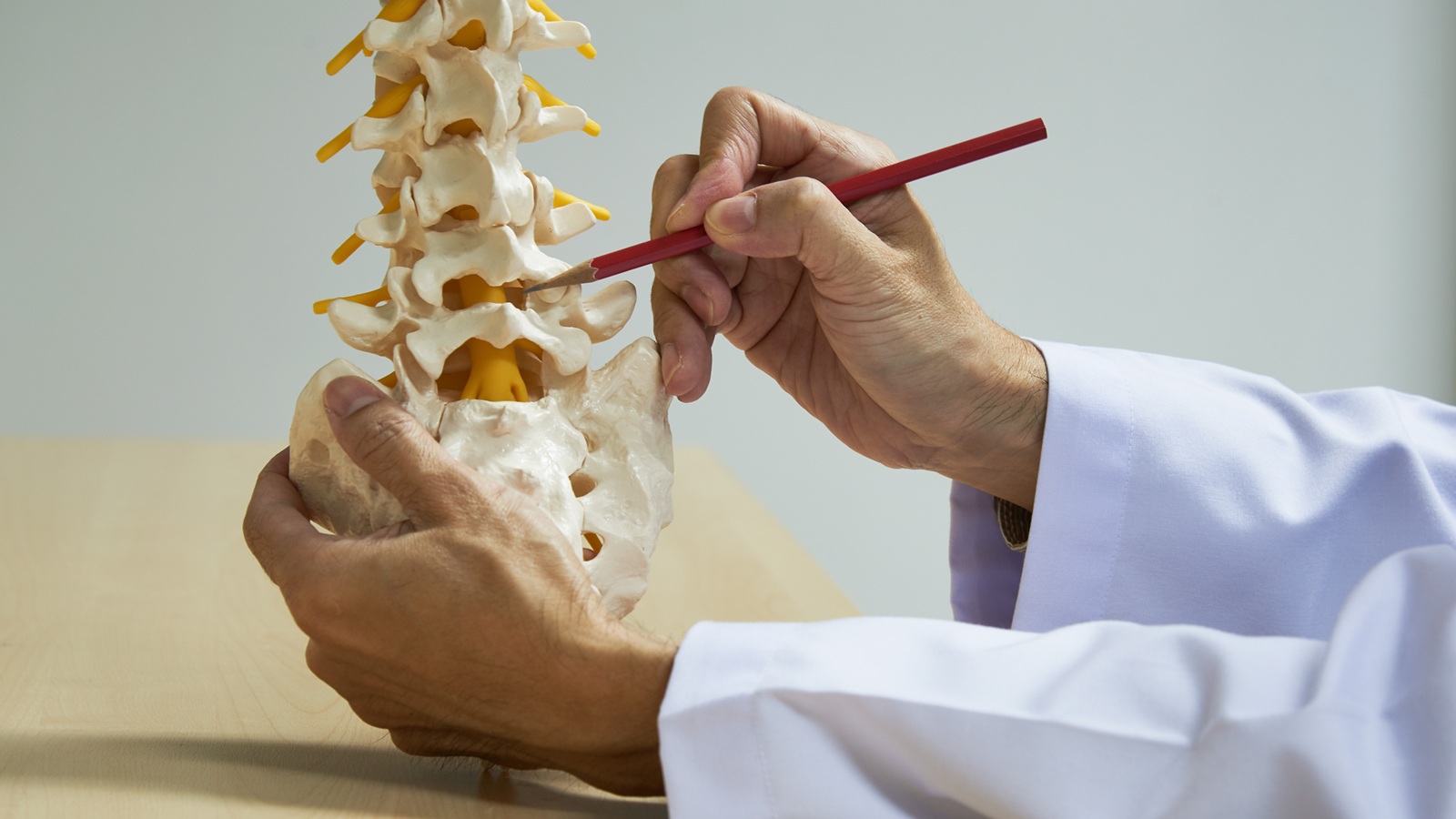

Does your lower back ache after standing or walking, only to feel better when you sit down or lean forward? That pattern, especially when paired with pain shooting down your leg, may point towards a condition called lumbar spondylolisthesis.
Lumbar spondylolisthesis occurs when a vertebra in your lower back slips forward over the bone beneath it. This can pinch the nerves that travel through your spine. This article explains why this happens, what symptoms to watch for, and how doctors treat it, from physical therapy to surgery.
What is Lumbar Spondylolisthesis?
Lumbar spondylolisthesis occurs when a vertebra in your lower back slips forward over the bone below it.
When a vertebra shifts out of position, it can narrow the space where your spinal nerves travel. This narrowing often pinches the nearby nerves. That is why so many people experience lower back pain, tight hamstrings, and sciatica, the sharp pain that shoots down your leg.
Your lumbar spine sits at the base of your back and carries most of your body’s weight. Because of this constant load, the lower back is one of the most common places for vertebral slippage to occur. Here’s the thing worth knowing: many people have mild spondylolisthesis and never realize it, while others deal with symptoms that make everyday activities difficult.
It's time to get back
to doing what you love.
Types of Lumbar Spondylolisthesis
Doctors classify spondylolisthesis by what caused the vertebra to slip in the first place. Knowing your type helps guide which treatments make the most sense for your situation.
Degenerative Spondylolisthesis
This is the type doctors see most often in adults over 40. Over decades, the discs between your vertebrae lose water content and flatten, while the small joints connecting your vertebrae wear down. Research published in PMC outlines the conservative management of degenerative spondylolisthesis.
Sometimes, the ligaments that normally hold everything in place weaken enough that one bone can slide forward on another. Spinal arthritis often plays a role here.
Isthmic Spondylolisthesis
A stress fracture in a small piece of bone called the pars interarticularis causes this type. Think of the pars as a bridge connecting the front and back parts of each vertebra — learn more in our pars defect overview. When this bridge cracks, the vertebra loses stability and can slip forward.
Young athletes who repeatedly hyperextend their spines, like gymnasts, football linemen, and weightlifters, develop isthmic spondylolisthesis more often than the general population. The fracture itself is called spondylolysis, and when it leads to slippage, it results in a spondylolisthesis.
Congenital Spondylolisthesis
Some people are born with vertebrae that did not form properly during fetal development. The bone may be shaped in a way that makes it prone to slipping. Interestingly, this structural difference often causes no problems during childhood and only becomes symptomatic later in life when other age-related changes compound the issue.
Traumatic Spondylolisthesis
A direct injury, like a car accident or a hard fall, can fracture the spine and cause a vertebra to slip. This type is less common than degenerative or isthmic forms, but when it happens, it often requires more immediate attention.
Causes and Risk Factors
Beyond the specific types, several factors increase your chances of developing lumbar spondylolisthesis:
- Age: As you get older, your ligaments can lose their elasticity. They can get over-stretched, like an old rubber band, leading abnormal movement of a joint
- Repetitive stress: Jobs or sports that involve frequent bending, lifting, or twisting put extra strain on the lower back over time
- Family history: Some people inherit bone structures or connective tissue characteristics that make slippage more likely
- Certain activities: Gymnastics, football, and weightlifting involve movements that repeatedly stress the lumbar spine in ways that can lead to fractures or accelerated wear
Symptoms of Lumbar Spondylolisthesis
Not everyone with spondylolisthesis has symptoms. Some people discover the condition incidentally when getting imaging for something else entirely. Others, however, experience discomfort that interferes with work, sleep, and daily life.
The symptoms you experience depend largely on how much the vertebra has slipped and whether it is pressing on a nerve. Common complaints include:
- Lower back pain and stiffness: Worsens after prolonged standing or physical activity
- Sciatica: Sharp, burning, or electric pain traveling from buttocks down one or both legs
- Numbness or tingling: Sensations in legs or feet signaling nerve compression
- Leg weakness: Legs feel heavy; difficulty walking usual distances
- Positional patterns: Worsen with standing or walking; improve when sitting or leaning forward
Grades of Lumbar Spondylolisthesis
Doctors measure how far your vertebra has slipped using a grading scale based on the percentage of displacement. Higher grades generally correlate with more symptoms, though this is not always a perfect relationship.
Most people fall into Grade I or II, and many of them respond well to conservative treatment without ever needing surgery.
How Doctors Diagnose Lumbar Spondylolisthesis
Your doctor will start with a physical exam, checking your posture, how you move, and where you feel tenderness. They will also test your reflexes, muscle strength, and sensation in your legs to look for signs that a nerve is involved.
Imaging studies confirm the diagnosis and show exactly what is happening:
- X-rays: Reveal vertebral position and measure slippage percentage
- Flexion and extension X-rays: Show excessive vertebral movement indicating instability
- MRI scan: Reveals soft tissue abnormalities and detects nerve compression
Surgical Treatment for Lumbar Spondylolisthesis
Surgery becomes an option when conservative treatments fail to provide adequate relief, or when you experience progressive weakness or worsening nerve function. The goal is to relieve pressure on the nerves and stabilize the spine so the vertebra stops moving.
Lumbar Decompression
Surgeons remove bone or tissue that is pressing on your nerves through a procedure called laminectomy. By creating more space in the spinal canal, this surgery relieves the pain and other symptoms caused by nerve compression.
Spinal Fusion
This procedure joins the slipped vertebra to the bone below it using screws, rods, and bone grafts. Over time, the two vertebrae grow together into a single, solid segment. Fusion stops the painful movement between the bones and prevents further slippage — see our guide on spinal fusion surgery risks and benefits.
Minimally Invasive Spine Surgery
Newer techniques use smaller incisions and specialized instruments to perform decompression and fusion. These approaches often result in less tissue damage, reduced pain after surgery, and faster recovery times compared to traditional open surgery. Read more about minimally invasive lumbar spine surgery.
Nonsurgical Treatment for Lumbar Spondylolisthesis
The good news is that most people with spondylolisthesis improve without surgery. Conservative treatment focuses on reducing pain, strengthening the muscles that support your spine, and modifying activities that aggravate your symptoms.
Physical Therapy
A physical therapist will design a program of exercises to strengthen your core and back muscles. Stronger muscles provide better support for your spine and reduce the stress on the slipped vertebra.
Medication
Over-the-counter anti-inflammatory drugs like ibuprofen or naproxen reduce swelling and pain. Your doctor may prescribe stronger medications for short-term use during flare-ups, though long-term reliance on pain medication is generally not the goal.
Epidural Steroid Injections
When oral medications do not provide enough relief, injections can deliver anti-inflammatory medication directly around the irritated nerve roots. These injections offer relief that lasts weeks to months, giving you a window to make progress with physical therapy.
Tip: Many patients find that combining physical therapy with medication management provides significant improvement within a few months. Surgery is rarely the first step.
Recovery and Outlook after Treatment
Most people with lumbar spondylolisthesis improve significantly with proper treatment. Your recovery timeline depends on which path you take.
Conservative care typically shows results within weeks to a few months. You may notice gradual improvement in pain and function as your muscles get stronger and inflammation decreases.
Surgical recovery takes longer. Most patients return to light activities within a few weeks, but full recovery, especially after fusion, can take several months. Following your care team’s guidance throughout this process improves your chances of a good outcome.
When to See a Spine Specialist
Consider scheduling an evaluation if you experience:
- Lower back pain that does not improve with rest or over-the-counter medication
- Pain, numbness, or weakness that spreads to your legs
- Difficulty walking or standing for normal periods
- Symptoms that interfere with work, sleep, or daily activities
Seek immediate medical attention if you experience sudden loss of bladder or bowel control, or rapidly worsening weakness in your legs. These symptoms may indicate a serious condition called cauda equina syndrome, which requires urgent care.
Personalized Lumbar Spondylolisthesis Care in New Jersey
Living with back pain can feel isolating, especially when you are not sure what is causing it or what your options are. At Neurosurgeons of New Jersey, our fellowship-trained spine specialists take time to understand your symptoms and explain your diagnosis in plain language. They will walk you through all available treatment paths.
We believe surgery is not always the answer. Many of our patients improve with physical therapy, medication, or injections, and we explore those options thoroughly before discussing surgical intervention. When surgery is appropriate, we offer advanced minimally invasive techniques designed to reduce recovery time and help you return to your life.
Request a consultation to discuss your symptoms and learn which treatment approach fits your situation.
Frequently Asked Questions About Lumbar Spondylolisthesis
What is the difference between spondylolisthesis and spondylolysis?
Spondylolysis is a crack or stress fracture in a vertebra, specifically in the pars interarticularis. Spondylolisthesis occurs when that fractured bone actually slips out of place. You can have spondylolysis without spondylolisthesis, but if the fracture weakens the bone enough, slippage can follow.
Does walking help lumbar spondylolisthesis?
It depends. Gentle walking helps some people stay mobile and reduces stiffness.
But it can worsen symptoms for others, particularly those whose pain increases with standing and walking. Your doctor or physical therapist can guide you on safe activity levels based on your specific situation.
What activities should you avoid with lumbar spondylolisthesis?
High-impact sports, heavy lifting, and exercises that involve excessive backward bending or twisting often aggravate symptoms. Your spine specialist can provide specific guidance based on your grade of slippage and which movements trigger your pain.
Can lumbar spondylolisthesis get worse over time?
In some cases, yes. The slip can progress, especially without treatment or with continued strain on the spine.
Regular monitoring and following your treatment plan can help prevent the condition from worsening. Many people with mild slippage, however, remain stable for years.

About Dr. Alfred T. Ogden
Dr. Alfred T. Ogden is an accomplished neurosurgeon in North Jersey and is a proud member of Neurosurgeons of New Jersey, practicing out of their Ridgewood office conveniently located on East Ridgewood Avenue. Dr. Ogden is internationally recognized as a leader in minimally invasive spine surgery.