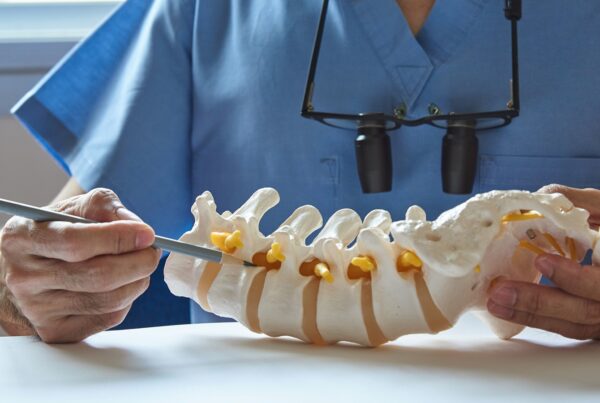
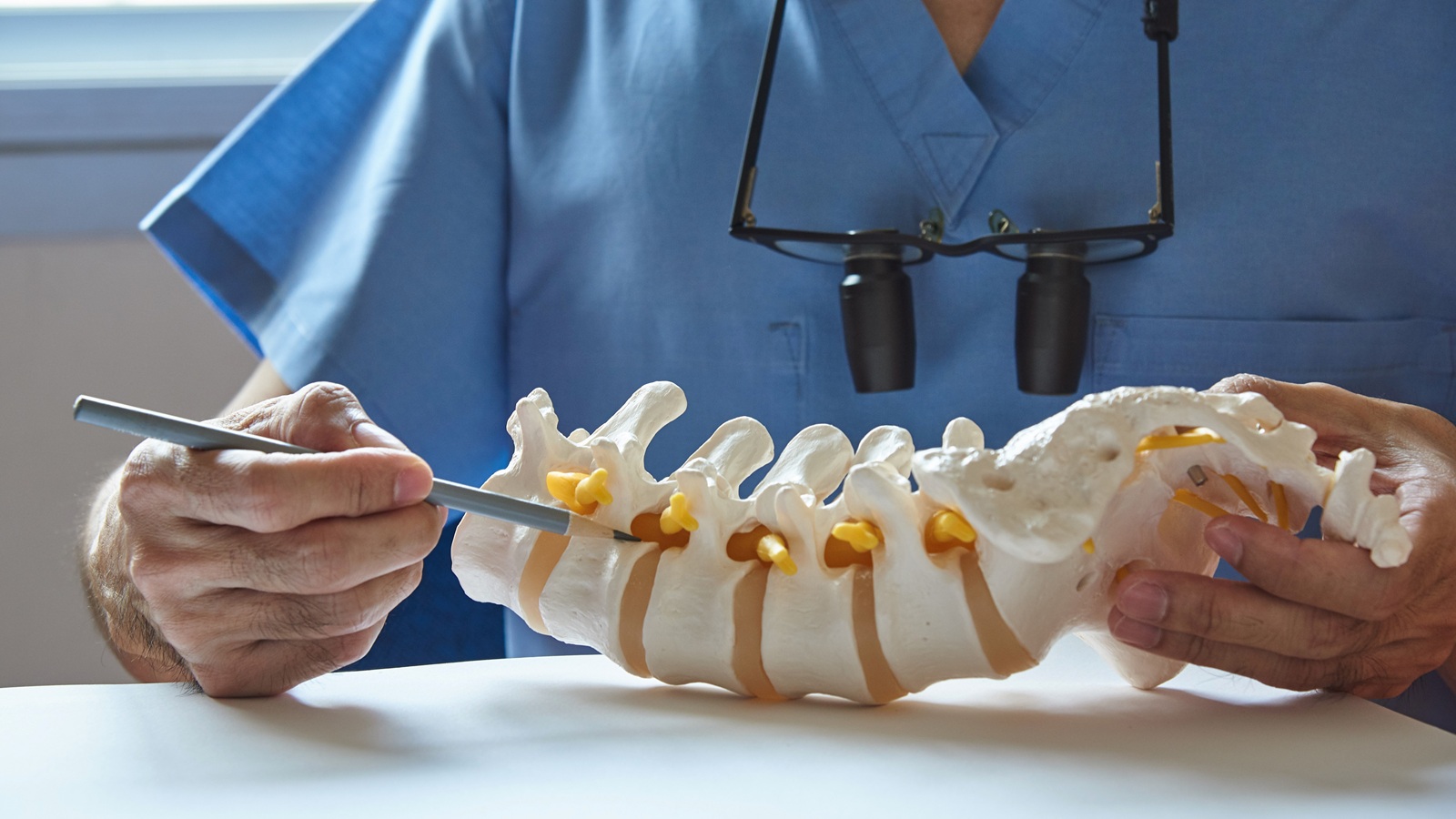

Your surgeon mentioned spinal fusion, and TLIF and PLIF sound alike. Both fuse vertebrae in the lower back, but they use different paths to reach the spine. That difference affects nerve handling, tissue disruption, and early recovery.
What is lumbar interbody fusion?
During lumbar interbody fusion, the surgeon removes a damaged disc and places a spacer, called a cage, between the vertebrae above and below it. Over the following months, bone grows through and around the cage until the vertebrae form one solid segment.
TLIF and PLIF both approach the spine from the back. The right option depends on your anatomy, diagnosis, imaging, and the areas that need decompression.
What is posterior lumbar interbody fusion (PLIF)?
PLIF stands for posterior lumbar interbody fusion. “Posterior” means the surgeon approaches through the back.
During PLIF, the surgeon makes an incision along the lower back and removes bone from both sides of the spine, often through a bilateral laminectomy. The nerve roots are gently moved aside, and two smaller cages are typically placed in the disc space.
PLIF can be useful when narrowing on both sides of the spinal canal requires decompression because it gives the surgeon direct access to both sides.
What is transforaminal lumbar interbody fusion (TLIF)?
TLIF stands for transforaminal lumbar interbody fusion. The surgeon reaches the disc through the foramen, the opening where a nerve root exits the spine.
TLIF approaches from one side. The surgeon removes the facet joint on that side to create a path to the disc, then places one larger cage across the disc space. Because the opposite side remains largely untouched, TLIF generally requires less nerve retraction and tissue disruption than PLIF.
Key differences between TLIF and PLIF
Surgical approach and nerve handling
PLIF accesses the disc from both sides and typically uses two cages. TLIF accesses it from one side and usually uses one cage. By limiting nerve retraction, TLIF may reduce the risk of nerve irritation or injury.
Fusion rates and long-term outcomes
Both procedures achieve similar fusion rates. Long-term results depend more on choosing the right procedure for the patient, surgical technique, bone quality, overall health, and adherence to recovery instructions.
When might a surgeon recommend PLIF?
Although TLIF is commonly performed, PLIF may be preferred when:
- Both sides of the spinal canal require decompression.
- Previous surgery makes one-sided access difficult.
- A patient’s anatomy makes a unilateral approach less suitable.
A spine surgeon should match the procedure to your individual needs rather than use one technique for every patient.
It's time to get back
to doing what you love.
Minimally invasive options
Both procedures may be performed through smaller incisions with specialized instruments. Minimally invasive TLIF is particularly common because its one-sided approach works well through a narrow corridor.
Some surgeons also use navigation or robotic assistance when placing screws and cages. These tools may reduce muscle damage or improve placement accuracy, but the best approach depends on your case and your surgeon’s experience.
Recovery after TLIF and PLIF
Recovery timelines are broadly similar, although TLIF may allow a somewhat easier early recovery because it disrupts less tissue.
Most patients stay in the hospital for one to three days. You will generally need to avoid bending, lifting, and twisting for several weeks. Physical therapy may begin after initial healing to rebuild strength and mobility. Your care team will tailor these instructions to your procedure and health.
Questions to ask your surgeon
- Why do you recommend this approach for me?
- Do I need decompression on one side or both?
- Am I a candidate for minimally invasive surgery?
- What risks are specific to my condition?
- What should I expect during recovery?
- How often do you perform this procedure?
At Neurosurgeons of New Jersey, our fellowship-trained spine specialists review your imaging, symptoms, and treatment history before recommending an approach. We consider surgery appropriate only when conservative treatments have not provided sufficient relief.
Request a consultation to discuss your spine care.
Talk with a fellowship-trained spine surgeon in New Jersey
Choosing between TLIF and PLIF depends on your diagnosis, anatomy, and treatment goals. The right procedure effectively addresses your condition while minimizing risk. Your surgeon can explain how these factors apply.
Frequently asked questions
What are the disadvantages of TLIF surgery?
Every spine procedure has potential benefits, limitations, and risks. Because TLIF approaches the disc from one side, it may provide less direct access to the opposite side of the spinal canal. The procedure also typically requires removing part of a facet joint and using screws and rods to stabilize the spine. Your surgeon will determine whether TLIF is appropriate based on your symptoms, anatomy, diagnosis, and treatment goals.
Does TLIF include spinal decompression?
Yes. Removing the facet joint and part of the lamina creates access to the disc and relieves pressure on affected nerves.
Is TLIF or PLIF more painful during recovery?
TLIF and PLIF are two approaches to lumbar spinal fusion. Neither procedure is automatically better or less painful for every patient. A spine surgeon recommends the approach best suited to the location of nerve compression, the condition being treated, prior procedures, spinal anatomy, and other individual factors. Recovery and postoperative discomfort can vary according to the extent of surgery and the patient’s overall health.
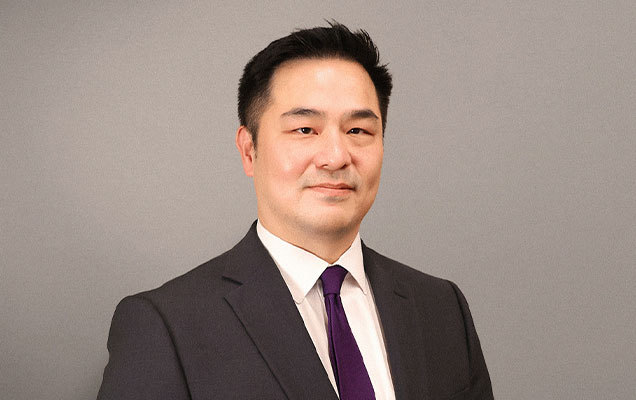
About Dr. Jonathan Yun
Dr. Jonathan Yun is a board-certified neurosurgeon who focuses on helping patients with spine disorders. He uses advanced, minimally invasive techniques to reduce recovery time and make surgery safer and less painful. With tools like computer-guided systems, advanced imaging technologies, and robotic-assisted surgery, Dr. Yun is able to provide precise, tailored care. His expertise covers a wide range of treatments, from highly targeted procedures to alleviate pressure on nerves to performing minimally-invasive fusions and correcting spinal deformities. Dr. Yun is currently accepting new patients.